Time Machine Backup For Lion Mac Air Clean Download UPDATED
Time Machine Backup For Lion Mac Air Clean Download
 | |
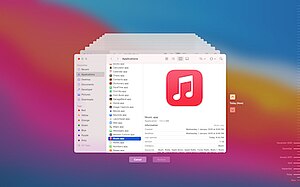 Time Car'due south retrieval interface on macOS xi | |
| Operating arrangement | macOS x.v or newer |
|---|---|
| Type | Backup software |
| Website | support |
Fourth dimension Auto is the backup mechanism of macOS, the desktop operating organization developed by Apple tree. The software is designed to piece of work with both local storage devices and network-attached disks, and is most commonly used with external disk drives continued using either USB or Thunderbolt. Information technology was first introduced in Mac OS X 10.5 Leopard, which appeared in Oct 2007 and incrementally refined in subsequent releases of macOS. Time Machine was revamped in macOS xi Big Sur to support APFS, thereby enabling "faster, more compact, and more reliable backups" than were possible previously.[1] [2]
Overview [edit]
Fourth dimension Machine creates incremental backups of files that can exist restored at a later date.[3] It allows the user to restore the whole system or specific files. It also works within a number of applications such as Post and iWork, making it possible to restore individual objects (e.g. emails, contacts, text documents, presentations) without leaving the awarding. According to an Apple support statement:
"Time Motorcar is a backup utility, not an archival utility, it is non intended as offline storage. Time Machine captures the virtually recent state of your data on your disk. As snapshots age, they are prioritized progressively lower compared to your more recent ones."[four]
For backups to a network drive, Fourth dimension Machine allows the user to back up Mac computers over the network, and supports backing up to certain network attached storage devices or servers, depending on the version of Time Machine. Earlier versions worked with a wide diversity of NAS servers, only later versions require the server to support a recent version of Apple'south Apple tree Filing Protocol (AFP) or a recent version of the Server Bulletin Block (SMB) protocol, and Time Machine no longer works with servers using earlier versions of SMB.[5] Some of the legacy back up can be re-enabled by using hand-tuned configuration options, accessed through the Terminal. Apple tree's Time Capsule, which was introduced in 2008 and discontinued in 2018, acted as a network storage device specifically for Fourth dimension Motorcar backups, allowing both wired and wireless backups to the Time Capsule's internal difficult drive. Time Machine may also be used with other external or internal volumes.
Fourth dimension Machine saves hourly backups for the by 24 hours, daily backups for the past month, and weekly backups for everything older than a calendar month until the volume runs out of infinite. At that point, Time Motorcar deletes the oldest weekly backup.[6]
Revamp in macOS Big Sur [edit]
Time Machine was overhauled in macOS 11 Big Sur to utilize APFS, Apple tree's modern file organisation kickoff introduced in 2016. Specifically, the new version of Fourth dimension Machine makes use of APFS'southward snapshot technology.[1] [7] [eight] According to Apple, this enables "faster, more than compact, and more than reliable backups" than were possible previously with HFS+-formatted drives.[ane] [2] An independent evaluation of this merits found that macOS 11'due south Time Machine implementation in conjunction with APFS was 2.75-fold faster upon initial local backup and four-fold faster upon subsequent backups relative to macOS 10.15's Time Machine implementation using HFS+.[2] A more pocket-size even so nonetheless significant advantage was noted too for backups to network-fastened disks.[2]
New local (i.e. USB- or Thunderbolt-continued) and network-continued Time Car fill-in destinations are formatted as APFS past default, though Time Machine tin go on backing up to existing HFS+ backup volumes."[1] At that place is no option to convert existing, HFS+-based backups to APFS; instead, users who want to do good from the advantages of the new, APFS-based implementation of Fourth dimension Car need to showtime with a fresh book.[2]
At least in some circumstances, encryption appears to be required (instead of just optional) in the new version of Time Machine.[ii]
User interface [edit]
Time Motorcar'due south user interface when retrieving a file uses Apple tree's Core Blitheness API. Upon its launch, Time Automobile "floats" the active Finder or application window from the user's desktop to a backdrop depicting the user's blurred desktop wallpaper. Behind the current agile window are stacked windows, with each window representing a snapshot of how that binder or application looked on the given appointment and time in the by. When toggling through the previous snapshots, the stacked windows extend backwards, giving the impression of flying through a "time tunnel." While paging through these "windows from the past", a previous version of the information (or currently deleted data) may be retrieved.
Storage [edit]
Time Machine works with locally connected storage disks, which must be formatted in the APFS or HFS+ volume formats. Support for backing up to APFS volumes was added with macOS 11 Large Sur and since then APFS is the default volume format.
Time Machine also works with remote storage media shared from other systems, including Time Capsule, via the network. When using remote storage, Time Machine uses sparse bundles. This acts as an isolation layer, which makes the storage neutral to the actual file organisation used by the network server, and likewise permits the replication of the fill-in from one storage medium to another. Sparse bundles are mounted by macOS like any other device, presenting their content as a HFS+ formatted volume, functionally similar to a local storage.
Requirements [edit]
Time Auto places strict requirements on the fill-in storage medium. The only officially supported configurations are:[9]
- A storage drive or partition connected straight to the computer, either internally or by a bus like USB or Thunderbolt and formatted as APFS or journaled HFS+. If the book format is not right, Time Machine will prompt the user to reformat information technology.
- A folder on another Mac on the same network.
- A drive shared by an Apple Time Capsule on the same network.
- A drive connected to an Apple Drome Extreme 802.11ac model on the same network. (Before generations of the Drome Extreme are not supported.)
- Local network volumes connected using the Apple tree Filing Protocol or via an SMB3 share that advertises a number of capabilities.[v]
On a Time Capsule, the backup data is stored in an HFS+ disk image and accessed via Apple Filing Protocol. Although it is not officially supported, users and manufacturers take too configured FreeBSD and Linux servers and network-attached storage systems to serve Time Car-enabled Macs. There are likewise a few software tools available on the marketplace that can copy files inside Time Machine backups in Windows machines.[10] [11] [12] [13] [14] [15] [16] [17]
Performance [edit]
Fourth dimension Machine creates a folder on the designated Time Motorcar volume (local or within a remote sparse prototype) into which it copies the directory tree of all locally attached storage drives, except for files and directories that the user has specified to omit, including the Fourth dimension Machine volume itself. Every hour thereafter, it creates a new subordinate binder and copies only files that have changed since the last backup and creates (in the case of HFS+ volumes) hard links to files that already exist on the backup drive. A user tin can browse the directory hierarchy of these copies as if browsing the master deejay.[18]
Another backup utilities save deltas for file changes, much like version control systems. Such an arroyo permits more frequent backups of small changes, but can often complicate the interaction with the backup volume. By contrast, it is possible to manually browse a Time Machine backup volume without using the Time Motorcar interface; Time Machine presents each fill-in to the user as a complete disk copy.[18]
Time Auto on HFS+ volumes creates multiple hard links to unmodified directories.[xviii] Multiple linking of directories is a peculiar feature for HFS+, and is non supported on mod Unix file systems including Apple's own APFS.[xix] As a issue, tools similar rsync cannot be used to replicate a Fourth dimension Machine volume; replication tin only reliably exist done by imaging the entire filesystem.
Apple system events tape when each directory is modified on the hard drive. This means that instead of examining every file'south modification date when it is activated, Time Motorcar only needs to scan the directories that changed for files to copy. This differs from the approach taken past like backup utilities rsync and FlyBack, which examine modification dates of all files during fill-in.
Fourth dimension Auto is besides bachelor in the macOS installation process. One of the features in the Migration Assistant interface is to restore the contents of a Time Machine backup. In other words, a difficult drive can be restored from a Fourth dimension Machine backup in the event of a catastrophic crash.
OS X Mount Lion introduced the ability to use multiple volumes simultaneously for Time Machine operations. When the user specifies more than i book to utilize, macOS rotates amid the desired volumes each time it does a backup.[20]
Exclusion [edit]
Fourth dimension Automobile supports two forms of exclusion: one based on a user-configured list of paths (plus a set of organisation defaults), the other based on the extended file attribute com.apple.metadata:com_apple_backup_excludeItem dependencies. Since the attribute is applied to the file or directory straight, moving or copying will not affect the exclusion. The attribute should comprise the cord com.apple tree.backup in any belongings listing format. Writing com.apple.MobileBackup instead sets the exclusion for iOS backups.[21]
Google Chrome is known to utilise the attribute to exclude its histories.[21] Third-party backup applications that respect this setting include CrashPlan and Arq.[22] Apple tree wraps the attribute into the tmutil command-line utility[21] every bit well every bit a CoreServices API.[23]
See likewise [edit]
- MobileMe Backup
- List of backup software
- Version command
- Drome Time Capsule
- Backup options built into Microsoft Windows: System Restore, File History
References [edit]
- ^ a b c d "macOS Large Sur eleven.0.1 Release Notes". Apple . Retrieved December 13, 2020.
- ^ a b c d due east f Cunningham, Andrew (November 12, 2020). "macOS 11.0 Big Sur: The Ars Technica review". Ars Technica. Retrieved March half dozen, 2021.
- ^ Apple tree. "Apple - Mac Bone 10 Leopard - Features - Time Machine". Retrieved December 21, 2007.
- ^ "Time Machine keeps maxim non enough space | Communities". discussions.apple tree.com . Retrieved Oct 21, 2017.
- ^ a b "Fourth dimension Machine over SMB Specification". Documentation Annal. Apple Inc. September 13, 2016. Retrieved April 24, 2019.
- ^ Tiwari, Saurabh (May seven, 2018). "Create a fill-in with Time Machine on Mac". Techi Bhai . Retrieved Feb sixteen, 2022.
- ^ Owen, Malcolm (June 27, 2020). "APFS changes affect Fourth dimension Machine in macOS Large Sur, encrypted drives in iOS fourteen". Apple Insider. Retrieved Baronial half dozen, 2020.
- ^ Oakley, Howard (June 20, 2020). "APFS changes in Big Sur: how Time Motorcar backs up to APFS, and more". The Eclectic Calorie-free Company. Retrieved August 6, 2020.
- ^ "Backup disks you tin use with Time Auto". Apple Support. Apple Inc. Retrieved November thirty, 2020.
- ^ Matthias Kretschmann. "HowTo: Brand Ubuntu A Perfect Mac File Server And Time Motorcar Volume". Retrieved September xi, 2009.
- ^ MKurtz. "NSLU2-Linux - HowTo / TimeMachineBackups". Retrieved September 11, 2009.
- ^ harryd71. "Mac Bone X Time Machine and FreeNAS 0.7". Retrieved Jan 17, 2010.
- ^ QNAP Systems Inc. "QNAP NAS back up for Apple Time Machine". Retrieved November thirty, 2020.
- ^ Bastian Bechtold. "Using a Raspberry Pi as a Fourth dimension Capsule for Mount Lion". Retrieved August 23, 2012.
- ^ Alonso, Noel. "Using Netatalk: AFP Services on a Linux Server". AFP548.com. Retrieved Nov 1, 2013. Also run into slowfranklin's comment and its replies. To add together the guest UAM, add
AFPD_UAMLIST="-U uams_guest.and then"to the[Global]section inafp.conf. - ^ Bas van de Wiel. "Ironclad Time Machine backups on FreeBSD". Retrieved March 18, 2016.
- ^ Amar Ilindra. "How to Access and Restore Fourth dimension Automobile Fill-in Files on Windows".
- ^ a b c Pond, James (August 31, 2013). "How Time Machine Works its Magic". Apple tree OSX and Time Machine Tips. baligu.com. File Organization Upshot Shop,Hard Links. Retrieved May 19, 2019.
- ^ Butts, Jeff (September 25, 2017). "Time Machine and APFS: What Yous Need to Know". The Mac Observer . Retrieved Apr 23, 2019.
- ^ Caldwell, Serenity (February 21, 2012). "Ten exciting system changes in Mountain Lion". Mac-globe. Retrieved Apr 29, 2012.
- ^ a b c Bobby, Brant. "macos - On OS X, what files are excluded past rule from a Fourth dimension Automobile fill-in?". Ask Different.
- ^ "Feature Asking: Award com_apple_backup_excludeItem on MacOS · Issue #478 · gilbertchen/duplicacy". GitHub.
- ^ "CSBackupSetItemExcluded - Core Services". Apple Developers Documentation.
External links [edit]
- Apple Back up: Back upward your Mac with Time Machine
- Mac OS X ten.5 Leopard review on Ars Technica
- brief history of Time Car and its evolution to using APFS, past Howard Oakley
DOWNLOAD HERE
Posted by: beckergrely1979.blogspot.com

